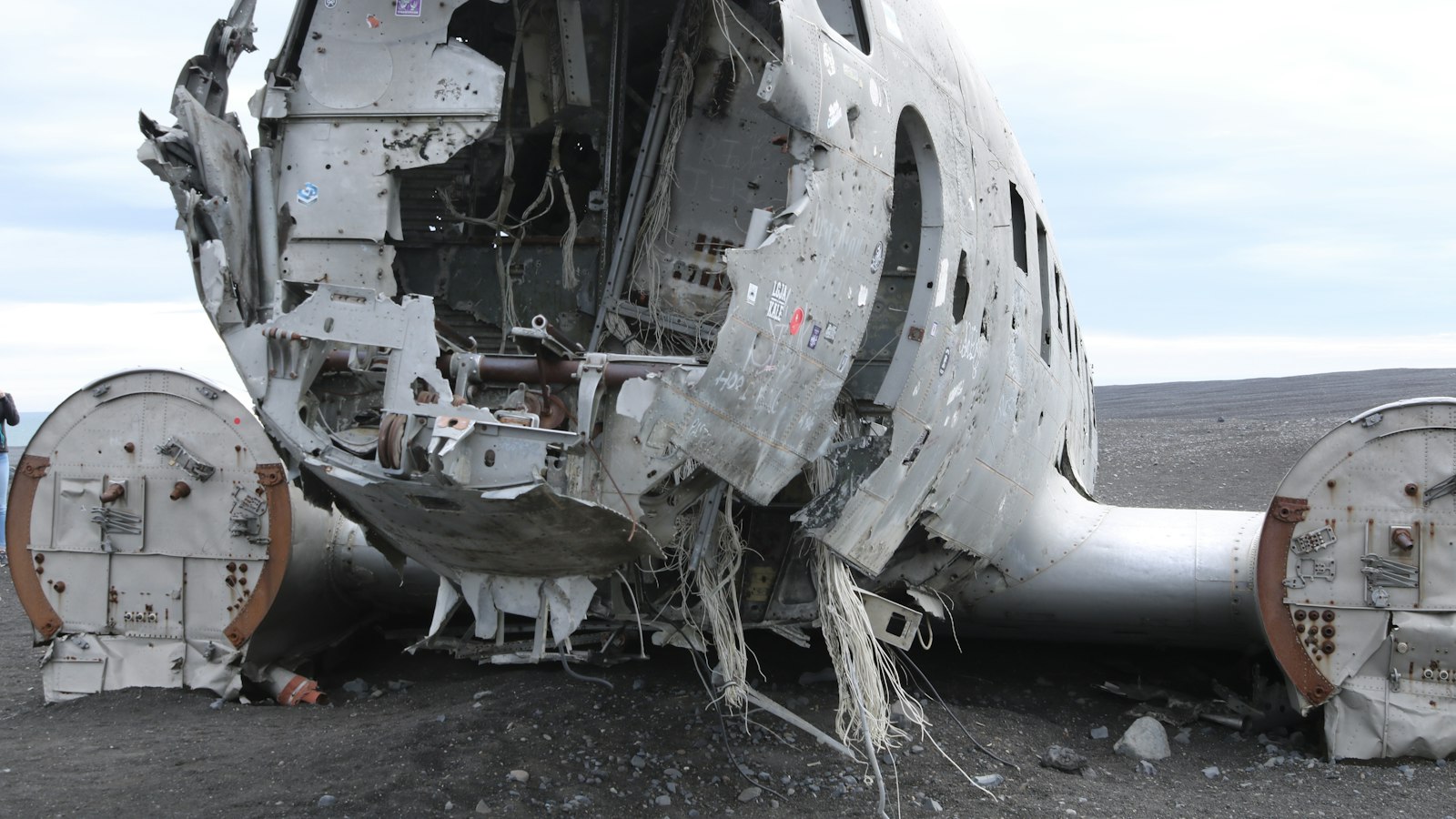
On the stark Sólheimasandur glacial outwash plain in South Iceland, the remains of a US Navy Douglas DC-3 aircraft attract crowds of photographers and sightseers each year. The scene has appeared in films, television commercials and music videos, including a notable appearance in the 2007 Sigur Rós documentary and Justin Bieber’s “I’ll Show You.” The contrast of the plane’s battered grey metal against the vast, black sands is a familiar image for many.
The 1973 crash and survival
The crash occurred on the afternoon of November 21, 1973. The DC-3 was travelling from Höfn in Hornafjörður (a large fjord and town in southeast Iceland) to Keflavík, having completed a delivery to the US Radar Station at Stokkses. Weather conditions were severe, with temperatures below minus 10°C, thick fog and strong winds. Debate remains about the exact cause of the crash, but the main theory is that the plane ran out of fuel after the pilot mistakenly switched to the wrong tank during rough weather.
Piloted by James Wicke and co-piloted by Gregory Fletcher, the plane encountered engine failure amid a storm. Fletcher decided to attempt an emergency landing rather than risk mountainous terrain or the sea. Through the clouds, the crew found themselves above a visually unique, flat, sandy stretch resembling a lunar landscape. Fletcher managed to put the plane down on the frozen beach, stopping just a few metres from the ocean. All five crew members survived without injury, although the aircraft itself was heavily damaged.
After the crash: abandonment and legacy
Following the safe evacuation, the crew waited only around an hour before being collected by a US rescue helicopter. The US Navy assessed that salvaging the plane would be too difficult, as it was about four kilometres from the nearest road. After removing valuable equipment, the empty aircraft was left at the site. It later served as storage for a local farmer and was even used for shooting practice by hunters.
Gregory Fletcher received an Air Medal Bronze Star for his actions during the emergency landing that saved his colleagues’ lives. The plane itself, a Douglas C-117 “Super DC-3,” was one of four stationed at Keflavík to monitor North Atlantic military activities during the Cold War. These aircraft had seen service in both the Korean and Vietnam wars before their deployment in Iceland. The US military presence at Keflavík ended in 2006.
Visiting the site today
Reaching the wreck involves a walk of about an hour each way along a designated path marked with metal posts. This route is straightforward, but may be slippery in places, and is often exposed to strong winds. Visitors should come prepared for the conditions with suitable clothing, food and water.
There is no charge to visit the site and people are free to explore the remains. However, the area can be hazardous, especially in poor weather or winter, when getting lost becomes a risk. The black sand, sea, and hidden rocks also present dangers. It is important to exercise caution and be aware of changing tides and one’s own limitations when exploring the Sólheimasandur plane wreck.