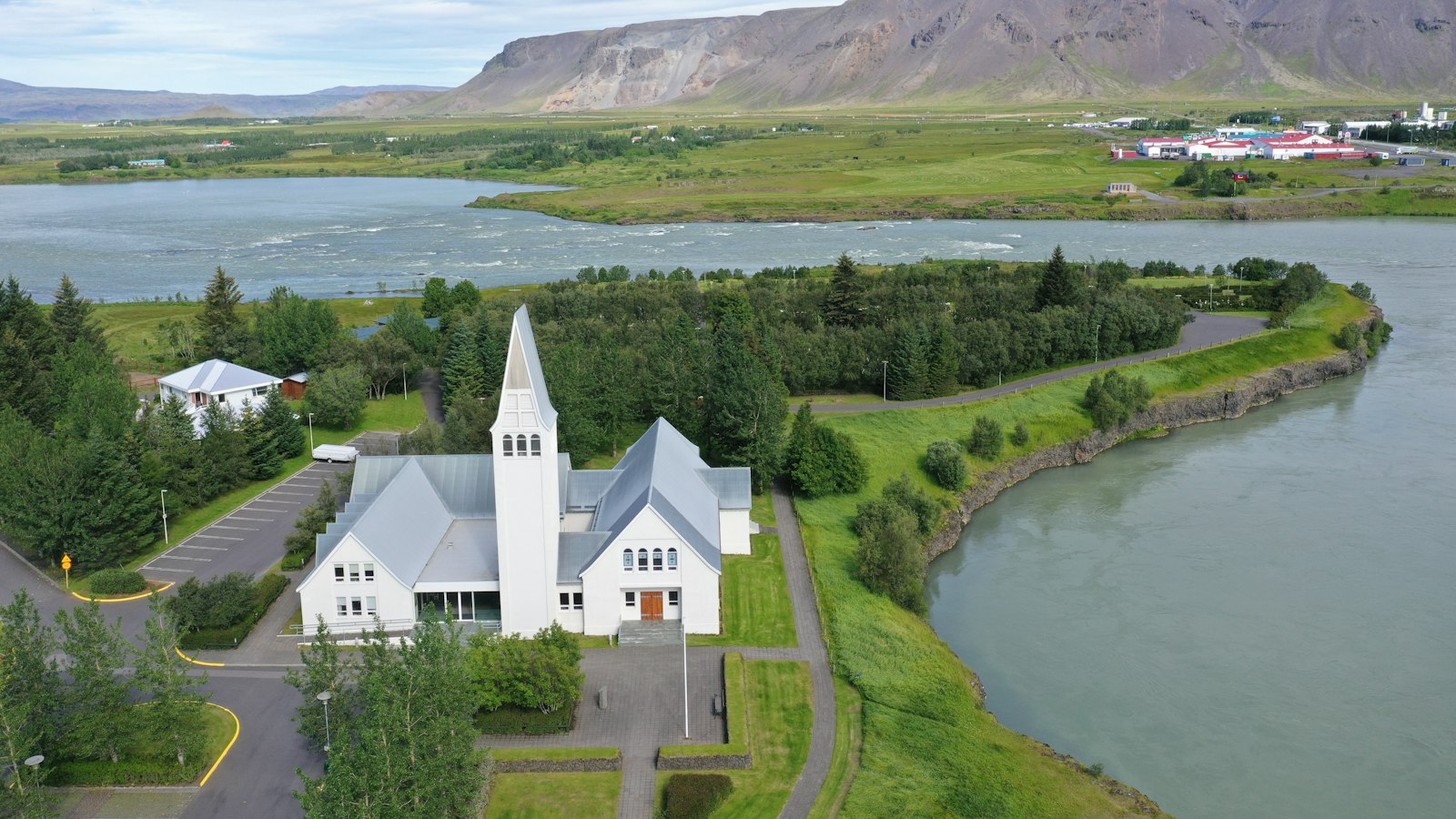
Ölfus, on Iceland’s south-west coast, is a region where ancient lava fields and centuries-old churches shape the pace of daily life. This municipality’s main town, Þorlákshöfn, sits along the coast and forms the practical and cultural heart of the area.
Caves, birdlife and a lava-sculpted landscape
Beneath its mossy surface, Ölfus is marked by impressive geological features. The lava tube called Raufarhólshellir extends for 1,360 metres with a ceiling height reaching 10 metres, making it one of Iceland’s longest. Nearby is Búri, another noteworthy cave, and the smaller but still substantial Arnarker, a 516-metre-long lava-formed tunnel. In the northwest, the Leitarhraun lava field spreads across the land, laid down some 5,000 years ago.
At the surface, Lake Hlíðarvatn stretches over 3.3 square kilometres, known locally for its rich birdlife and mild depth of up to five metres. The nearby Reykjadalur valley is dotted with hot wells and springs, continuing Iceland’s tradition of open-air bathing in naturally heated water.
Historic churches and local legends
Ölfus contains several wooden churches rooted in story and local art. Strandarkirkja, built in 1888 and renovated twice since, stands close to the coast. This church features a retable painted in 1865 by Sigurður Guðmundsson and has appeared in many Icelandic legends and documents. Inland in the hamlet of Hjalli, Hjallakirkja was constructed in 1928 but reportedly traces its foundation back to the early days of Christianity around the year 1000. The saga Flóamanna claims a settler named Skaftur Þóroddsson built it. Its pulpit dates from 1797, and the altar piece depicts Christ’s resurrection.
Kotstrandarkirkja, another wooden church from 1909, has a well-kept garden and was once shared by towns along the main road (Hringvegur). It is noted for church bells cast in 1644 and a retable from 1878 portraying Jesus with Peter, John and Jacob. Just offshore, the lighthouse Selvogsviti rises 20 metres above the bay at Selvogur, constructed as recently as 1991.
The coastline also features Fornigarður, an old stone wall running for seven kilometres. Its foundations revealed volcanic ash from Hekla’s 1104 eruption, suggesting the wall was built after that date. Erosion has worn it down over the centuries, but the wall is one of the area’s quiet landmarks.
A working town with modern rhythms
Today, Þorlákshöfn is more than just a fishing harbour. The town contains a town hall (Ráðhús Ölfuss), school, public library, health care centre and other essentials of rural Icelandic life. A swimming pool, sports centre and local shops signal the ways in which local families and workers keep old rhythms in step with the present. The spring in Ölfus also provides water for the Icelandic Glacial bottled brand, connecting the land’s clean resources with broader markets.
Throughout its history, Ölfus has experienced earthquakes, with some damage occurring in 1706 and 1896. Hills like Kögunarhóll, 61 metres high, overlook the landscape and witness the blend of daily routine, commemoration and natural beauty that define this quiet part of Iceland.
Sources
- Wikipedia
- Wikipedia (Icelandic) in Icelandic


