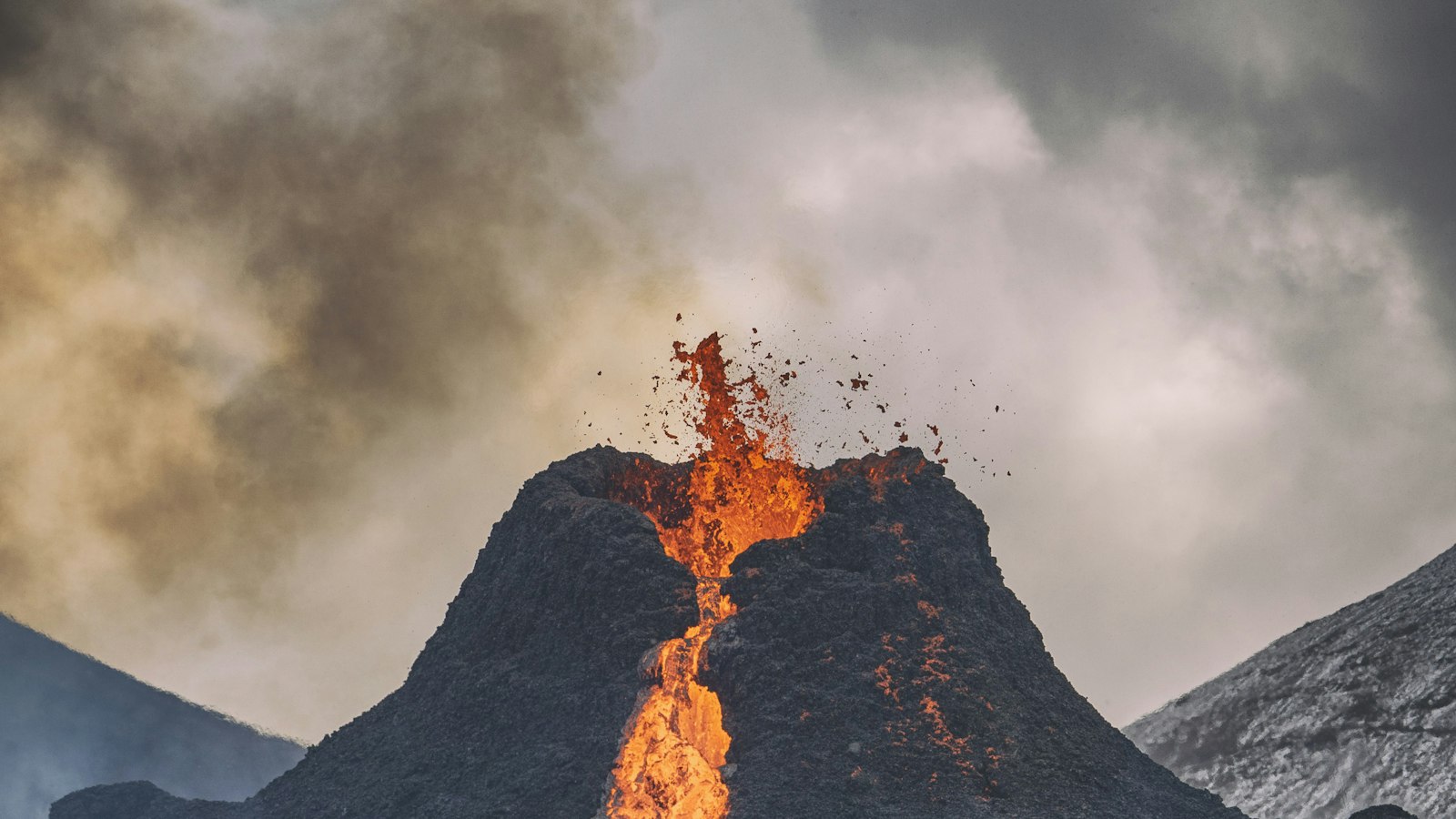
In the south of Iceland, the stratovolcano Hekla rises to 1,491 metres above sea level. With its distinctive profile, often likened to an upturned boat, Hekla is among the country’s most recognisable and active volcanoes. At 40 kilometres in length, the volcanic ridge’s most volcanically dynamic section is a 5.5 kilometre fissure known as Heklugjá, from which many eruptions emerge.
A gateway to hell in myth and reality
Hekla’s repeated, sometimes dramatic eruptions have left a deep mark not just on the terrain but also in folklore. Medieval Icelanders described the volcano as the “Gateway to Hell”; tales of its infernal fires were spread widely in Europe, sometimes by monks who likened its eruptions to the fiery cauldrons of Sicily. One 12th-century poem even names Hekla as the place where Judas was imprisoned. Well into the 19th century, some believed the volcano opened the way to the underworld and, according to legend, witches gathered on its slopes each Easter.
Eruptions have left a mark in less mythical ways as well. Because the tephra (volcanic ash and rock fragments) Hekla produces is distinctive and spread across vast regions, it forms crucial geological time markers not only for Iceland but also for archaeological sites in Scandinavia, Scotland and Ireland. In fact, about 10 percent of all tephra deposited in Iceland over the past thousand years originates from Hekla. Some prehistoric eruptions, such as the Hekla 3 eruption around 1000 BC, expelled so much ash that traces have been identified as far away as Scottish peat bogs and in Irish tree rings, which show a decade of poor growth afterwards.
Unusual geology and unpredictable eruptions
Geologically, Hekla sits where the South Iceland seismic zone and the eastern volcanic zone converge, at a rift-transform boundary along the mid-ocean ridge. Its form is an uncommon type, midway between a fissure vent and a typical stratovolcano. The magma chamber beneath Hekla is unusually deep for Iceland, reaching more than 10 kilometres below the surface. The volcano’s lava varies from silica-rich rhyolite through to basaltic andesite, and is unique in Iceland for also producing calc-alkaline lava types. The tephra Hekla emits contains significant fluorine, which can be poisonous to animals.
Eruptions have occurred at least twenty times since records began in 1104. The 1104 event, after at least 250 years of dormancy, was especially impactful, coating vast swathes of Iceland and rendering the valley of Þjórsárdalur uninhabitable. Hekla’s eruptions can be very short or last months, and may begin with explosive activity. Earthquakes usually provide only 30 to 80 minutes of warning before an eruption commences, sometimes even less.
While damage to livestock and settlements has been recorded throughout history, Icelandic attitudes towards Hekla have shifted. In the 18th century, scientists sought to debunk its reputation as an entrance to hell by climbing it themselves. Hekla remains under close observation, both for public safety and for the insight its activity provides into the dynamic forces shaping Iceland’s landscape and stories.
Sources
- Wikipedia
- Wikipedia (Icelandic) in Icelandic


