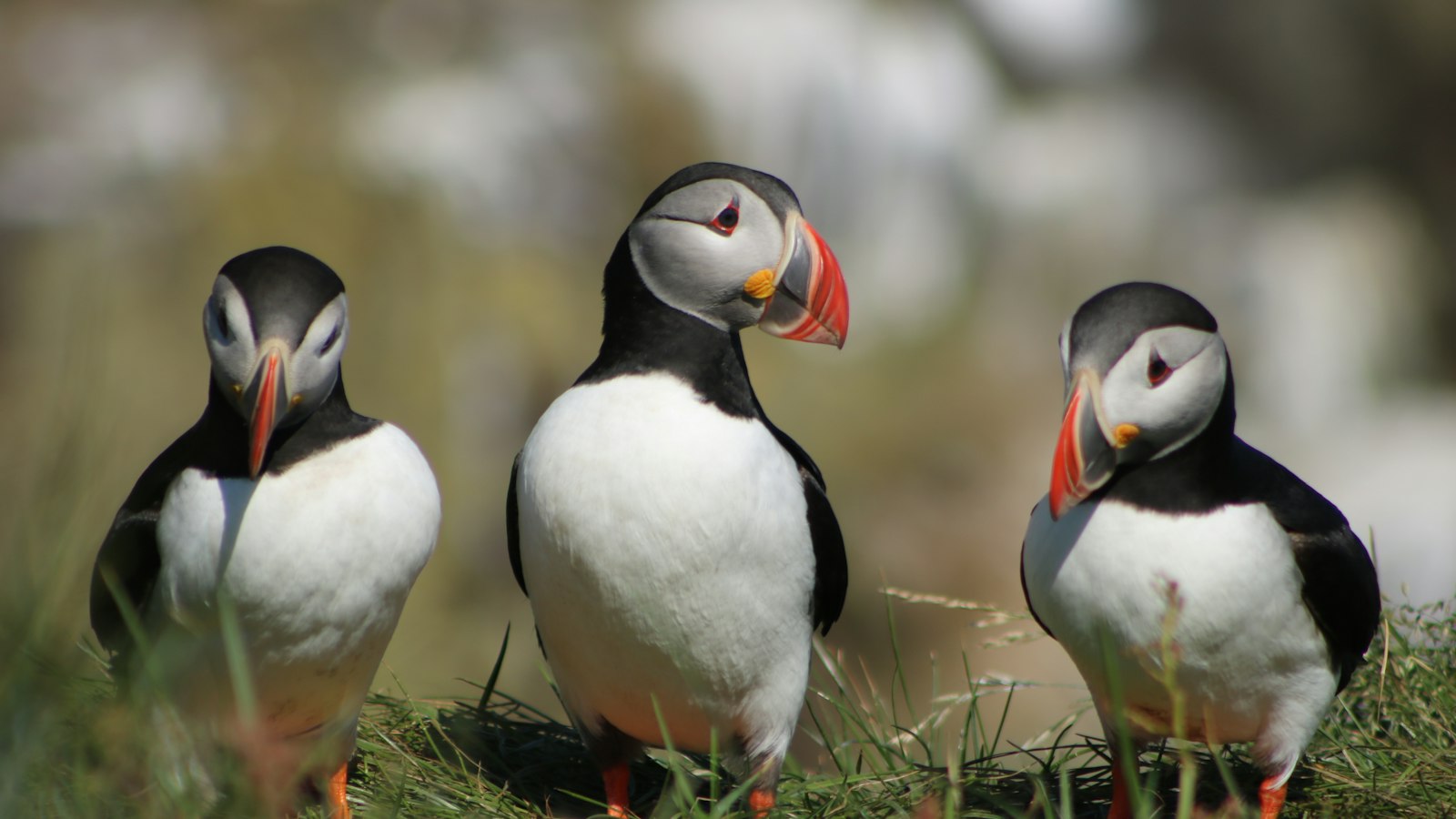
Among the seabirds found on the coasts of the North Atlantic, the Atlantic puffin (Fratercula arctica) stands out with its vivid beak and upright stance. Icelandic shores are home to most of the world’s population of this species. It is thought that around 60 percent of all Atlantic puffins breed in Iceland, making them the most numerous seabird on the island.
A seabird built for both sea and sky
Puffins are members of the auk family, closely related to the guillemots and razorbill. With a body length of 28–30 cm and a height of about 20 cm when standing, the Atlantic puffin is built with a thick neck, short tail, and striking black and white plumage. It has a black back, a white chest, grey cheek patches, and a boldly marked beak with red, blue, and yellow tones that becomes especially vivid in spring. Its orange legs make a strong contrast with its otherwise monochrome body.
Puffins are known for their remarkable diving abilities. They can dive to depths of up to 60 meters to catch small fish and other sea life. In the air, a rapid wingbeat, up to 400 times a minute, gives them top speeds near 88 km/h. Despite such agility, their waddle on land, upright posture, and expressive faces have led to nicknames like “clown of the sea” or, in Icelandic, “litli bróðir í norðri” (little brother of the north).
Life cycle and local lore
Each year, usually around mid-April to early May, mature puffins return from many months on the open sea to their cliff colonies, most abundantly in the Westman Islands (Vestmannaeyjar). Here, a single egg is laid in a burrow dug into the earth, where incubation lasts about 40 days. After hatching, the chick (called kofa or, in the Westman Islands, lundapysja) remains in the burrow for about 45 days before making its way to the sea, usually at night. These young birds will spend the first three to five years entirely at sea before returning to breed, often forming lifelong pairs.
The Atlantic puffin is a long-lived bird, with many reaching 20-25 years in the wild and the oldest known individual from Vestmannaeyjar living to 38 years.
The proximity of puffin colonies to towns in Vestmannaeyjar has led to a unique local tradition each August. As fledglings leave their burrows, some are drawn by the artificial lights and become disoriented, ending up in the streets. Residents, adults and children alike, gather to collect the wayward chicks in boxes and return them safely to the sea at dawn. Though the numbers of young birds have declined in recent years, the practice continues as part of the island’s relationship with its avian neighbours.
Sources
- Wikipedia
- Wikipedia (Icelandic) in Icelandic


