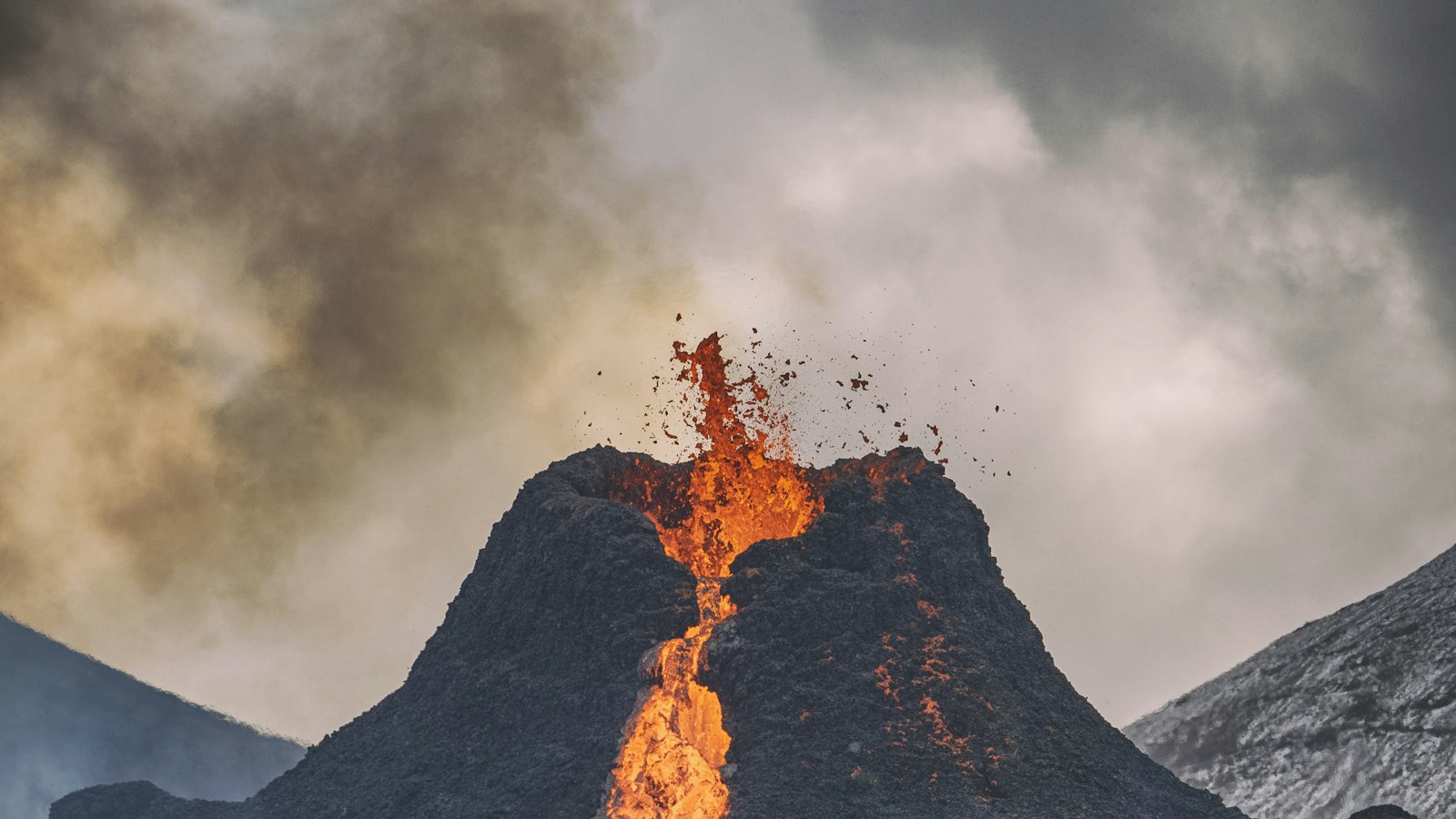
Iceland presents one of the planet’s most active volcanic environments, and its fiery nature is anchored in a geological feature known as the Iceland hotspot. This enigmatic force, deep under the island, has played a critical role in making Iceland what it is today, both above and below the surface.
A land shaped by lava and movement
Volcanic eruptions are almost part of Iceland’s rhythm, with over 45 on and around the island in the twentieth and early twenty-first centuries alone. Within recorded history, about one third of the world’s basaltic lava has erupted in Iceland. Some of the largest observed lava flows, such as from Eldgjá in the tenth century and Laki in the late eighteenth century, originated here. The newer eruption under the Eyjafjallajökull ice cap in 2010 illustrated how Iceland’s volcanoes can unleash not just lava but also destructive glacial floods.
Iceland is perched over the Mid-Atlantic Ridge, a massive underwater mountain chain marking the boundary where the Eurasian and North American tectonic plates drift apart. This alone encourages volcanic activity, but Iceland’s landmass stands out compared to other sections of the ridge, which mostly remain hidden below sea level as seamounts. The reason for this unusual uplift is the Iceland hotspot, a concentration of heat and water in the Earth’s mantle that amplifies volcanic processes.
Debate in the depths
The origins of this hotspot provoke debate among geologists. Some propose that a plume of abnormally hot rock rises from the lowest boundary of the mantle, nearly 2,900 kilometres beneath the Earth’s crust, and that this channel is about 100 kilometres wide. Others suggest the hot region may not reach so deep, but instead is limited to the uppermost mantle. Recent imaging of subsurface structures by seismologists has offered evidence for a hot conduit extending at least several hundred kilometres downward, though the findings invite different interpretations.
The presence of more water within the hotspot’s magma lowers the melting point further, making volcanic eruptions more likely and more voluminous. This crucial combination of heat, water, and plate tectonics gives Iceland its exceptional crustal thickness and vigorous igneous activity, compared to much of the Mid-Atlantic Ridge.
Some theories credit the hotspot with historic geological changes far beyond Iceland itself. The earliest volcanic rocks associated with the Iceland hotspot occurred as the Atlantic Ocean was just forming between 64 and 58 million years ago. The resulting activity influenced the geology of Greenland, Ireland, and Norway. Other effects, such as the uplift of the Scandinavian Mountains and the English chalklands, have also been attributed to the movement and impact of the Iceland plume.
Debates continue about the precise depth and origin of the hotspot. Alternative theories propose the existence of old oceanic plates in the mantle, or suggest that temperature contrasts with nearby ancient continental crust drive convection in upper mantle layers. These models seek to explain why this mid-oceanic island remains so unique among Earth’s volcanic landscapes.


