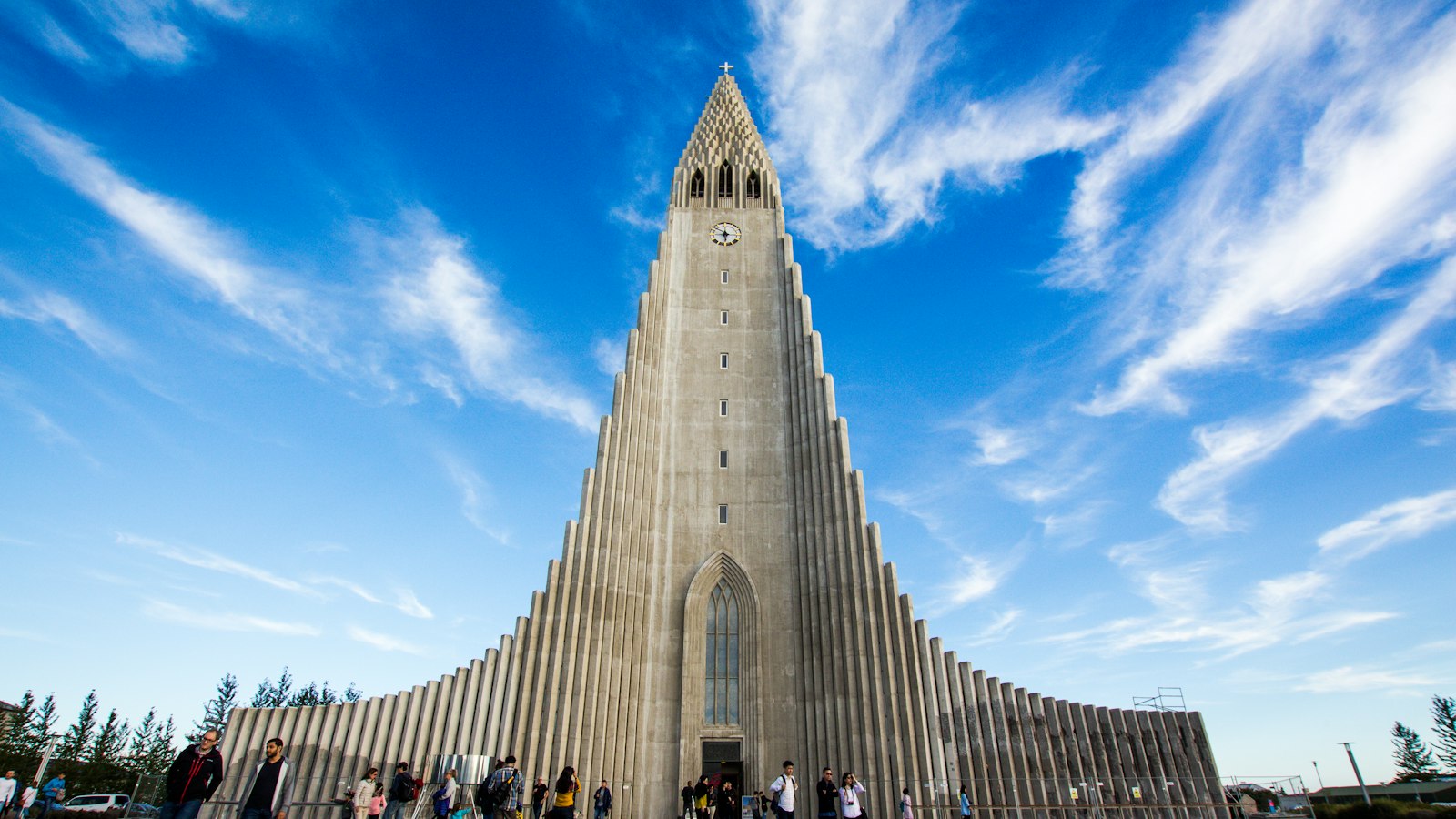
Visible from nearly every corner of Reykjavík, Hallgrímskirkja claims the city’s skyline with a presence that fuses sacred tradition and national identity. At 74.5 metres tall, it is Iceland’s tallest church and the second tallest building in the country. The church, completed in 1986 after over four decades of construction, stands high on Skólavörðuholt, a central Reykjavík hill.
A vision shaped by landscape and history
State Architect Guðjón Samúelsson’s design for Hallgrímskirkja was commissioned in 1937. He drew inspiration from the dramatic natural features of Iceland: from mountains and glaciers to the basalt columns seen in formations like Svartifoss. The church’s striking exterior, characterised by a curving spire and angled wings, echoes these natural shapes and contributes to its expressionist style, a break from traditional ecclesiastical architecture.
Behind its distinctive look lies the story of ambition: church leaders wanted to surpass the stature of Landakotskirkja, Reykjavík’s Catholic cathedral, leading to the creation of a large and dramatic spire. Critics at the time considered the result both old-fashioned and an eclectic mix of influences, but over time, the church has become a pillar of Icelandic national symbolism.
Layers of culture and sound
The church is named after Hallgrímur Pétursson, the 17th-century poet and cleric who authored the renowned Passion Hymns. A statue of Hallgrímur stands alongside three bells in the tower, named after himself, his wife Guðríður, and their daughter Steinunn. The carillon of 29 bells plays every quarter-hour from morning until evening, except during Protestant services.
Hallgrímskirkja’s role reaches beyond its spiritual mission. Its observation tower provides wide views of Reykjavík and the surrounding mountains, making it as much a city sentinel as a sanctuary. Just outside the entrance stands a statue of Leif Erikson, gifted to Iceland by the United States in 1930, commemorating a millennium since the Althing, parliament, was founded at Þingvellir in 930 AD.
Inside, the church offers another kind of visual and acoustic spectacle. Its main pipe organ, built in 1992 by Johannes Klais of Bonn, towers 15 metres above the sanctuary and weighs roughly 25 metric tons. With over 5,200 pipes, it is among the largest organs in Iceland, designed not only for worship but also for musical performances.
Hallgrímskirkja is the result of 41 years of planning and building, with stages marked by the consecration of the crypt in 1948, the completion of the steeple and wings by 1974, and the final dedication of the nave in 1986. Today, it stands as a testament to Iceland’s layered identity, mixing geological grandeur, artistry and community aspiration.
Sources
- Wikipedia
- Wikipedia (Icelandic) in Icelandic


