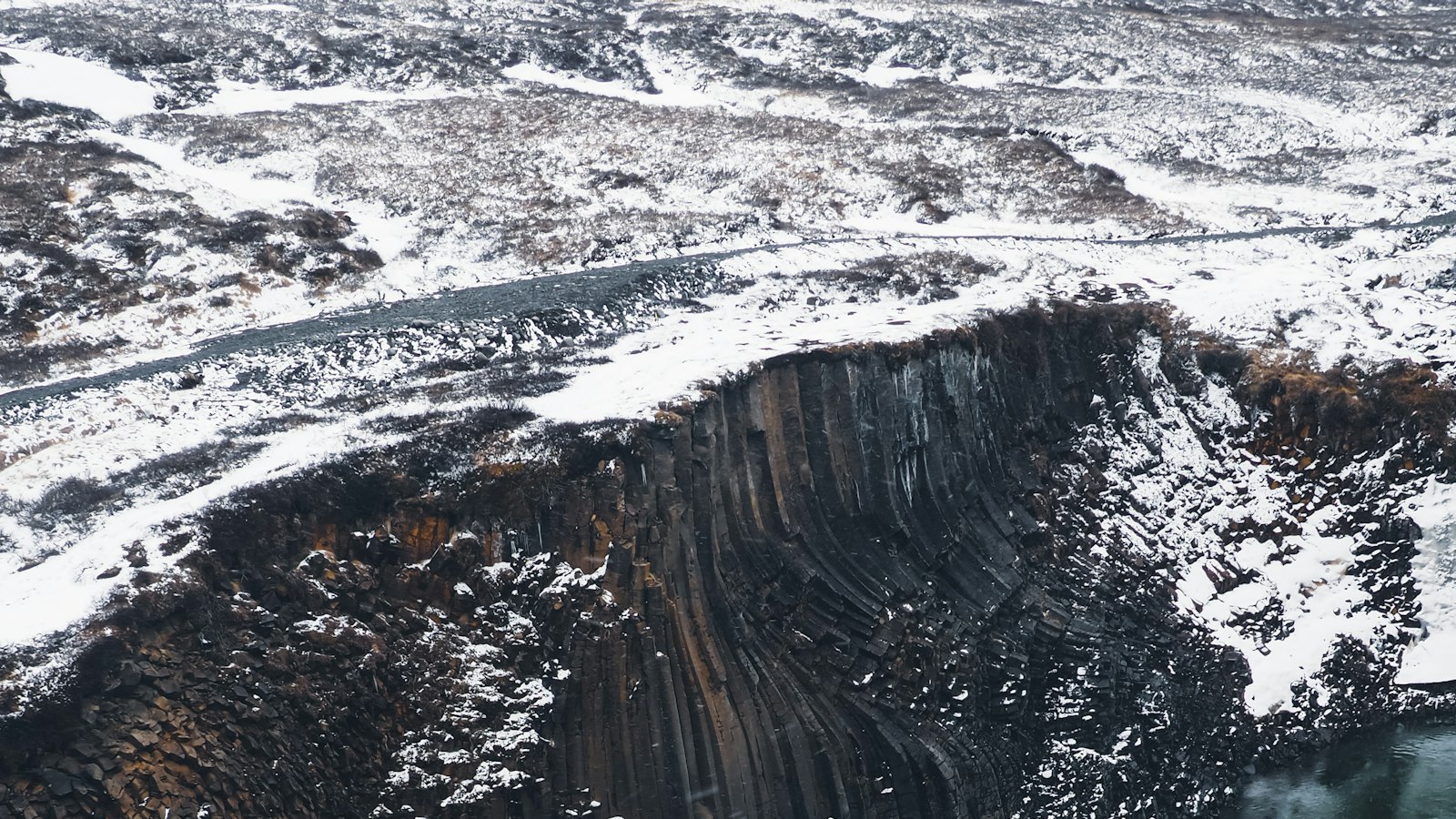
In the remote Jökuldalur valley of East Iceland, the canyon called Stuðlagil offers a striking scene. Its name comes from the Icelandic word “stuðlar” meaning “basalt columns” and “gil” for “canyon.” Here, countless pale-grey hexagonal stone pillars rise in strikingly even, vertical formations, some reaching up to 30 meters from the riverbed. For centuries, these natural sculptures lay mostly submerged and unknown, hidden by the heavy flow of one of Iceland’s longest glacial rivers.
Basalt columns shaped by fire and water
Stuðlagil’s dramatic stonework began millions of years ago, as thick sheets of lava cooled slowly after volcanic eruptions. The contraction and cracking of the cooling rock resulted in what is known as columnar jointing, patterns of hexagonal columns also found elsewhere in Iceland, but rarely at this scale or in such vertical order. These towers line the walls of the canyon, interrupted only by the vivid turquoise flow of the Jökulsá á Dal River.
The river’s unusual colour comes from glacial silt suspended in the water, especially in summertime when the source is clearer runoff from upstream reservoirs. Before 2009, this same river (known locally as Jökla) surged with more than twice its current volume, carrying thick sediment and running a muddy brown.
A canyon revealed by the changing Anthropocene
The major change to the landscape came from the Kárahnjúkar Hydropower Plant project. The dam, completed in 2009, diverted much of Jökulsá á Dal’s flow to power an aluminium smelter, dropping the river’s level by as much as 7 to 8 meters. As water receded, much of Stuðlagil Canyon was exposed for the first time in living memory. What appeared was a site of striking natural architecture, with tall, orderly columns now visible above the water and the river changing from cloudy brown to bright blue-green.
For nearly a decade, the canyon remained largely unrecognised beyond local farmers. In 2016, Icelandic photographer and writer Einar Páll Svavarsson brought wider attention by visiting, naming, and documenting the site in writing and photographs. His story introduced Stuðlagil to a global audience after being featured in an airline magazine. Soon after, media coverage and increased interest led to official recognition, and infrastructure developed to welcome more visitors.
The discovery also brought a curious twist, a case of what has been called “accidental conservation.” While the dam’s construction was controversial for flooding wilderness and waterfalls elsewhere, it inadvertently revealed a striking feature and revitalised the Jökuldalur region. Local farmers now help maintain the canyon and receive economic benefits from the increase in tourism-related activity, with more jobs and services in the area.
Safety and preservation challenges have grown along with popularity. In 2024 and 2026, two international visitors died after falling into the canyon. Seasonal river colour and access paths also change with weather. Yet for many in Iceland and abroad, Stuðlagil stands as a living example of nature’s artistry brought to light by human intervention, and a geological legacy written in basalt columns and turquoise water.
Sources
- Wikipedia
- Wikipedia (Icelandic) in Icelandic


